Bitcoin Is Missing a Central Bank. Strategy Is Building One.
Originally published on X
Related Research
This is Part 3 of a 3-part series. Read Part 1: Hiding in Plain Sight and Part 2: Is the Federal Reserve Evil?
This is what monetary infrastructure looks like when built on Bitcoin.
3 of 3
Central banks are not inherently broken. They are not inherently evil. For much of U.S. history, they worked.
From the creation of the Federal Reserve in 1913 through 1971, the United States operated under a monetary system anchored to gold. There were wars, recessions, and political failures, but the system itself remained constrained. Deficits were limited. Monetary discipline existed. A central bank operating on top of sound money proved durable.
The system broke in 1971 when the gold standard was abandoned with the Nixon Shock. Once the reserve asset became elastic, discipline dissolved. Deficits expanded structurally. After 2000, fiscal restraint effectively disappeared. The central bank did not suddenly become malicious. It became trapped inside a system with no anchor. Is the Federal Reserve Evil?
That distinction matters.
A central bank is not defined by authority. It is defined by structure. A central bank simply holds reserves, issues liabilities against those reserves, and adjusts policy levers to stabilize the system over time. Everything else is implementation detail.
Once you view central banking through that lens, something uncomfortable and obvious emerges. Strategy is no longer behaving like a company that merely owns Bitcoin. It is behaving like an institution organizing a monetary and credit system around Bitcoin.
Strategy has stated repeatedly that its objective is to become an issuer of digital credit and equity instruments. It has also signaled that it intends to move away from convertible issuance due to the distortions created by delta hedging. These are not tactical decisions. They are architectural ones.
What Central Banks Actually Do
When you strip away the mystique, the Federal Reserve operates through a small set of core functions. It holds reserves such as Treasuries and liquidity instruments. It issues liabilities through bank reserves and coordinated sovereign debt. It adjusts policy levers through interest rates, balance sheet expansion or contraction, and guidance. It intervenes during market stress to prevent disorder rather than to dictate prices. Its objective is stability, not moral outcomes.
This framework exists because credit systems cannot function at scale without volatility absorption. Markets require an entity capable of stabilizing expectations across cycles.
Now compare that structure to what Strategy has built.
Strategy’s Monetary Architecture
Strategy operates through three integrated monetary layers.
The first layer is Bitcoin as the reserve asset. Bitcoin is scarce, transparent, and globally verifiable collateral. It plays the role gold once played in sovereign systems. It is not used tactically. It is held to establish long-term credibility. Without this reserve layer, nothing else in the structure works. With over 700,000 Bitcoin, Strategy is no longer just a market participant, it occupies a position in the distribution that begins to resemble monetary infrastructure.
The second layer is preferred equity issued as digital credit; $STRC, $STRF, $STRK, $STRD, and $STRE. These are yield-bearing instruments issued against the balance sheet. They access the shared pool of Bitcoin into structured financial products, each with own payments schedule, yield, volume and etc. This is how sovereign monetary systems operate. Reserves support issuance, and issuance expands access to capital. See below.
The third layer is cash as a liquidity buffer. Cash allows the system to operate through volatility without liquidating the reserve asset. It signals solvency and protects confidence. It ensures obligations can be met regardless of market conditions. Strategy currently holds $2.25B or 30 months of dividends.
Together, these layers form a closed-loop monetary system rather than a speculative strategy.
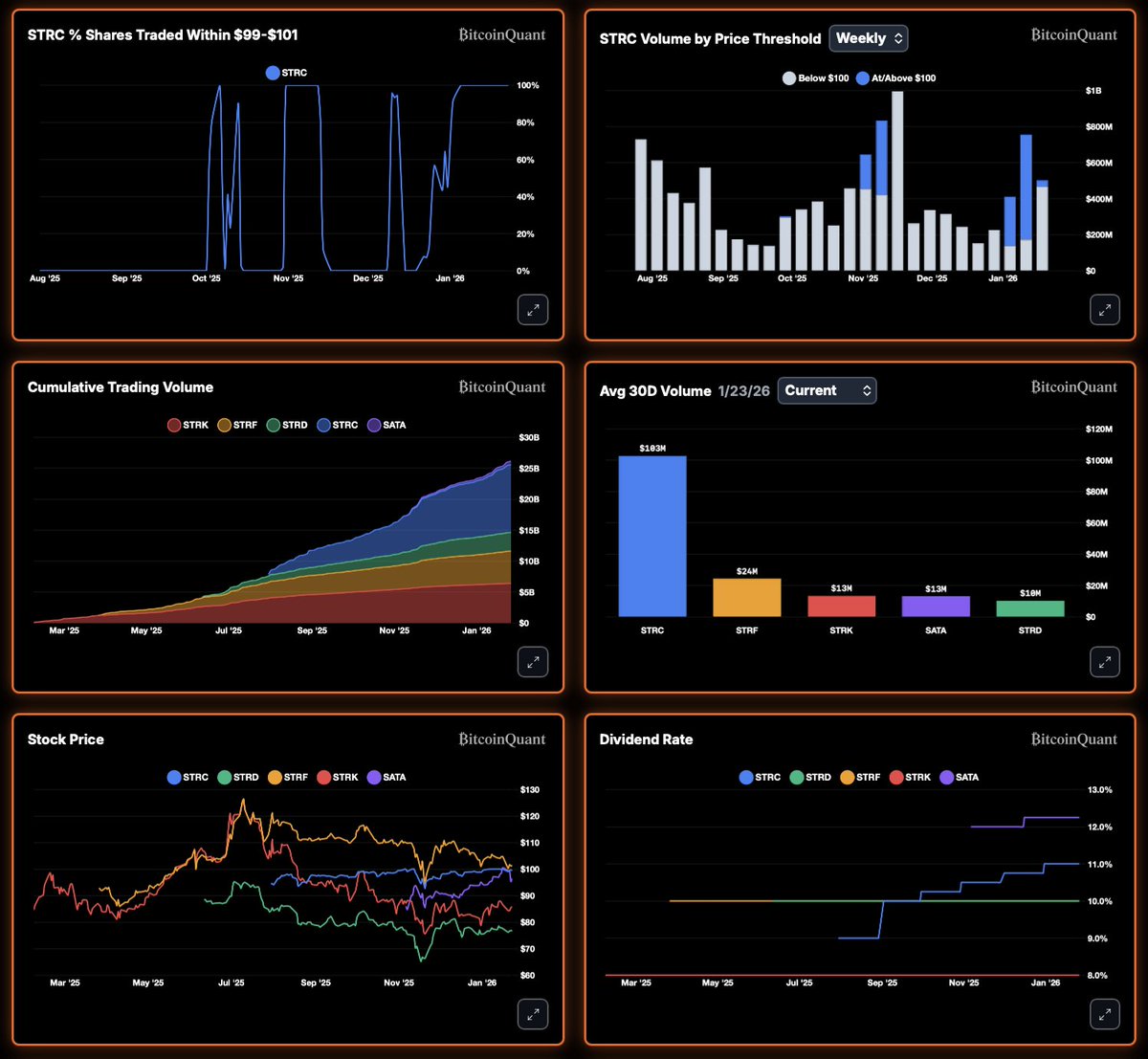
https://bitcoinquant.co/preferred-equity
Editor's note: BitcoinQuant went offline in August 2026. This citation now points to the Jan 17, 2026 Wayback snapshot (nine days before publication, matching the version the author sourced). A live equivalent is at /tools/strc-atm-tracker/.
STRC as Programmatic Monetary Policy
$STRC is where the central bank parallel becomes precise.
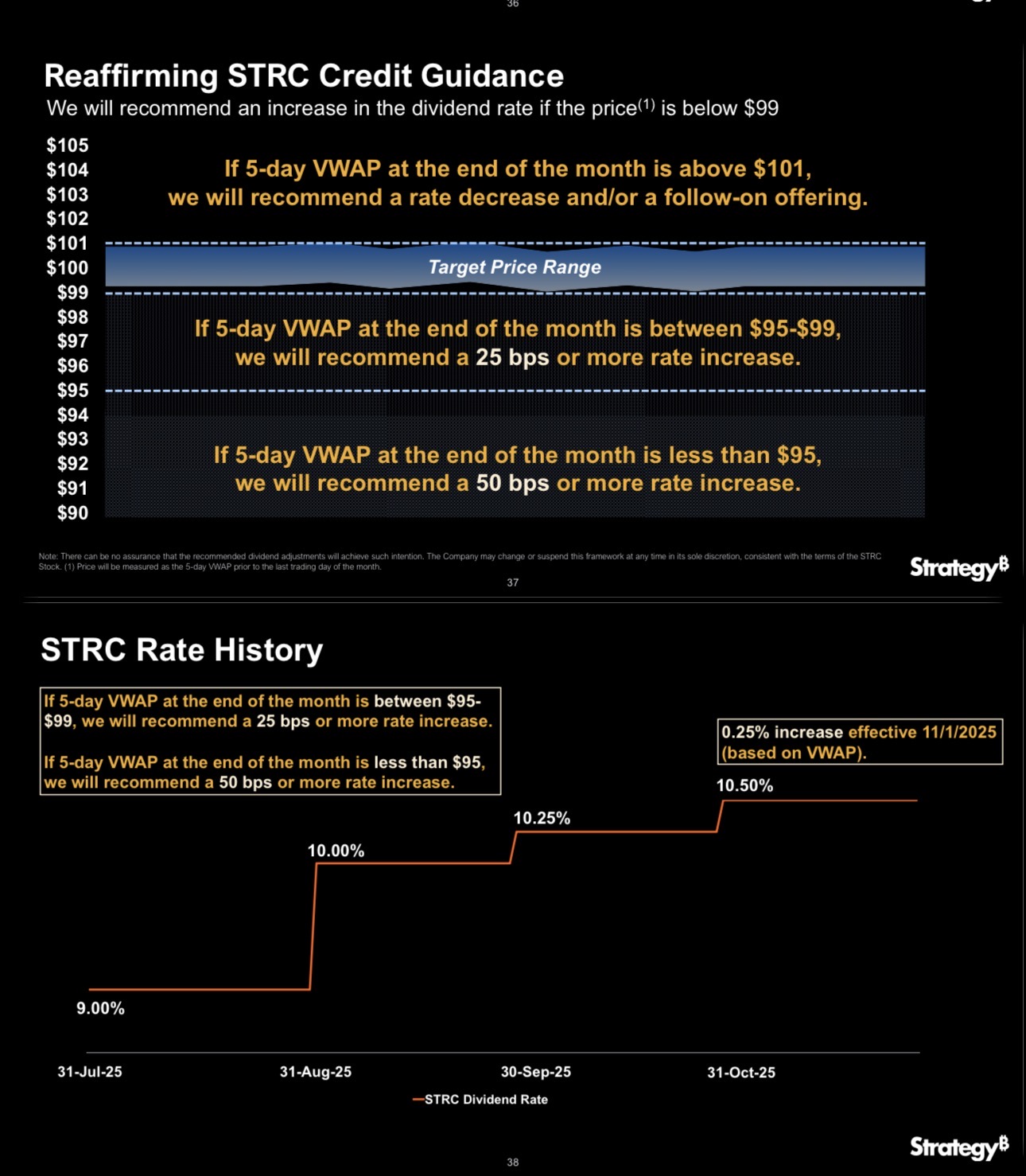
STRC includes explicit, published guidance tying dividend adjustments to the five-day VWAP at the end of each month. If the price drifts below the target range, the dividend rate increases. If the price rises above the range, the rate decreases and issuance may increase.
This is not discretionary guidance. It is a rule-based framework embedded directly into the instrument.
The Federal Reserve attempts to influence similar outcomes through committee decisions, messaging, and expectations management. Strategy encoded the logic mechanically. One system relies on human discretion. The other relies on incentives and predefined rules.
STRC behaves less like an equity and more like a price-stabilization instrument. It is not a stablecoin. It is a stable security with a self adjusting feedback loop. That is monetary engineering.
Strategy as Buyer of Last Resort
Central banks stabilize markets by acting as buyers of last resort.
They buy when liquidity disappears. They buy during panic. They buy during disorder.
Strategy’s Bitcoin behavior mirrors this pattern. Over nearly five years, it has accumulated Bitcoin in rising markets, falling markets, and sideways markets. This behavior is structural, not opportunistic.
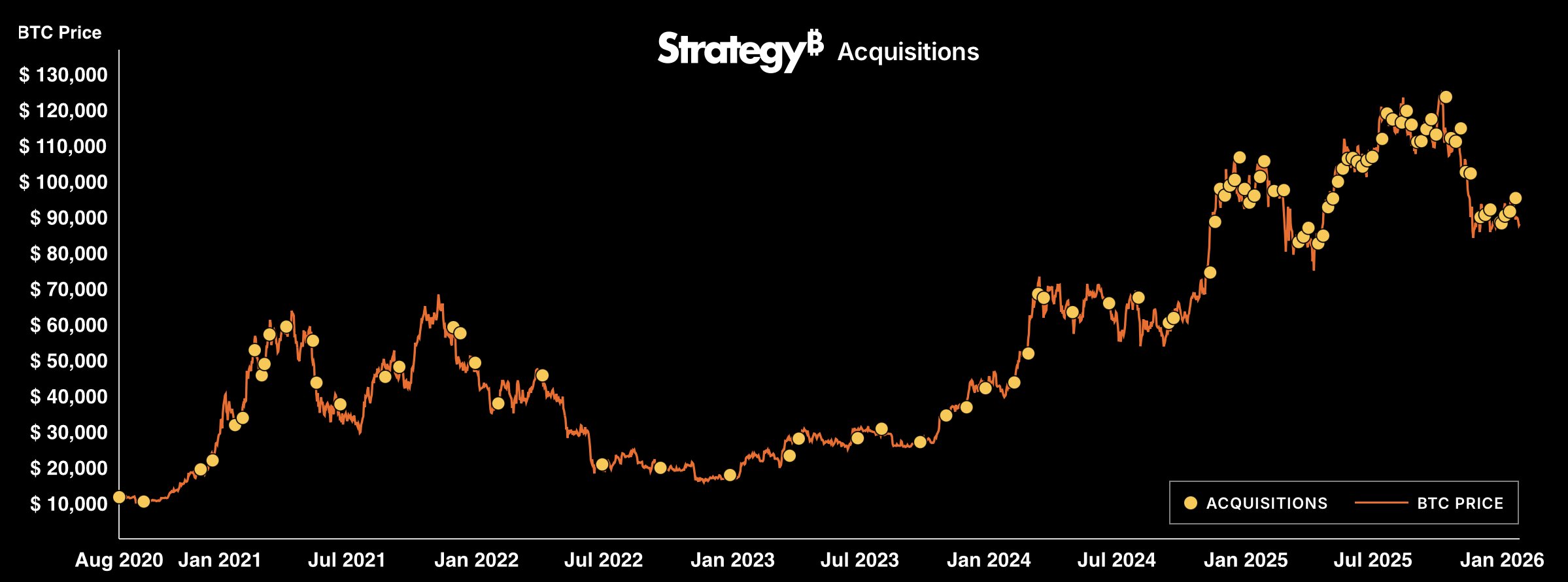
This matters because it changes Bitcoin’s market dynamics. Instead of being driven solely by speculative flows, Bitcoin now has a large, systematic accumulator that absorbs volatility over time. This does not control price. It dampens disorder.
How Whales Actually Operate
A common objection is that this represents dangerous concentration because Bitcoin whales already control hundreds of thousands of Bitcoin. That objection misunderstands how whales operate.
Some whales hold passively. Others trade actively. What fundamentally changed whale behavior was the introduction of Tether. Tether allowed whales to rotate between Bitcoin and a stablecoin trading pair, creating a cash-like buffer that enabled leverage, hedging, and rotation.
That system has limits. Whales do not control Tether issuance. They do not control the stability of the stablecoin (in comparison to $STRC, which Strategy controls). Whales cannot issue their own digital credit. Whales are not operating companies, so they can not issue equity. Their only leverage comes from posting Bitcoin or stablecoins on exchanges to access perps, margin, or short-term hedging strategies.
That is not a balance sheet. That is a trading strategy.
What Strategy Can Do That Whales Cannot
Strategy operates differently because it controls all three monetary layers internally.
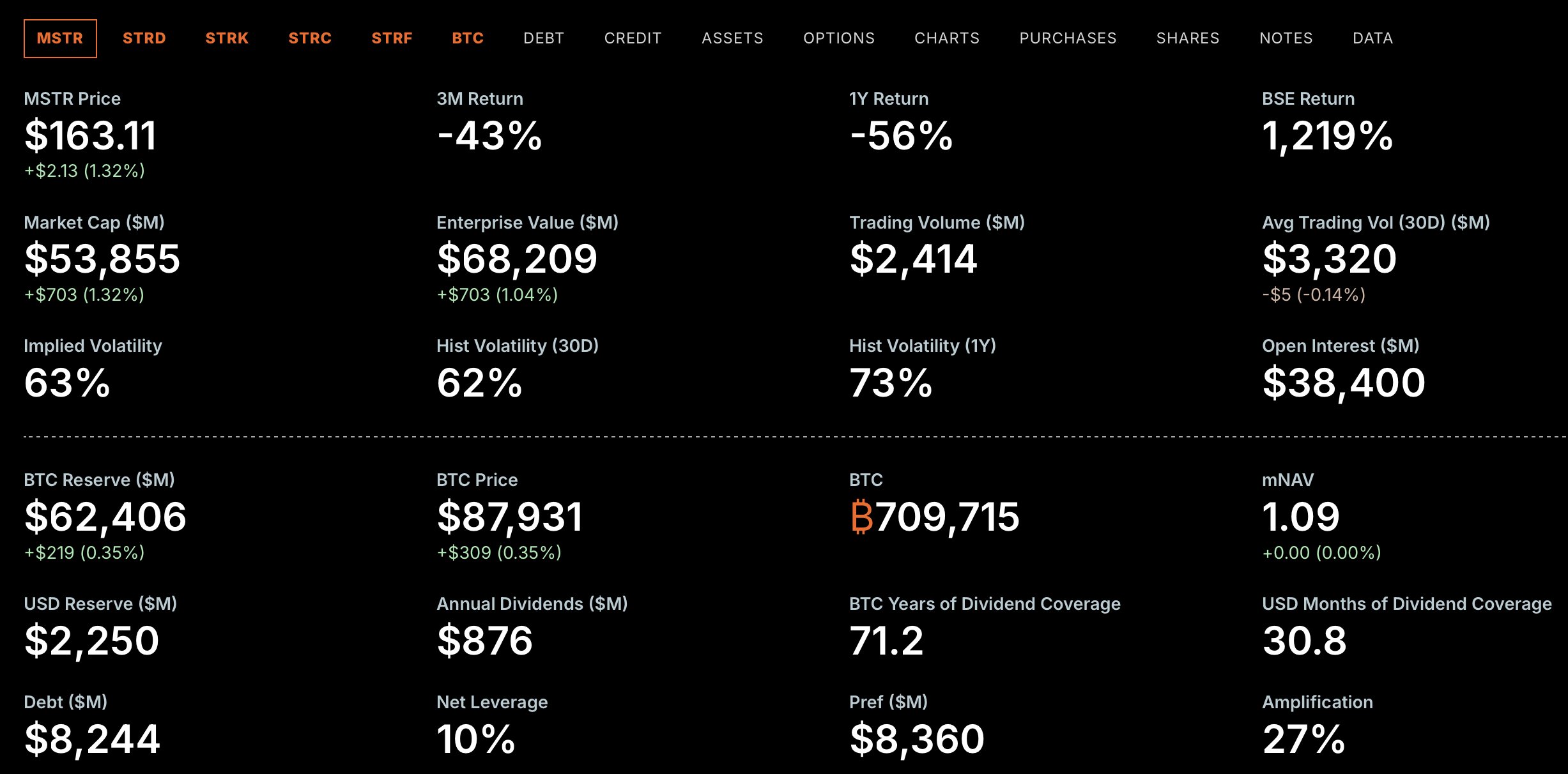
Strategy holds over 709,000 Bitcoin as a reserve asset. Strategy controls a cash buffer of approximately $2.25 billion. Strategy has issued over $8 billion in preferred equity, which functions as long-duration, effectively permanent capital in the form of digital credit.
Strategy also reshaped the accounting framework governing Bitcoin treasuries. Through the adoption of FASB fair value accounting under ASU 2023-08, Strategy can recognize Bitcoin appreciation on its balance sheet. It can report positive earnings without selling Bitcoin and without triggering the Corporate Alternative Minimum Tax, CAMT. No Bitcoin whale can do this.
Strategy is a U.S.-based operating company operating entirely within regulated capital markets. Many large whales operate offshore and outside U.S. exchanges.
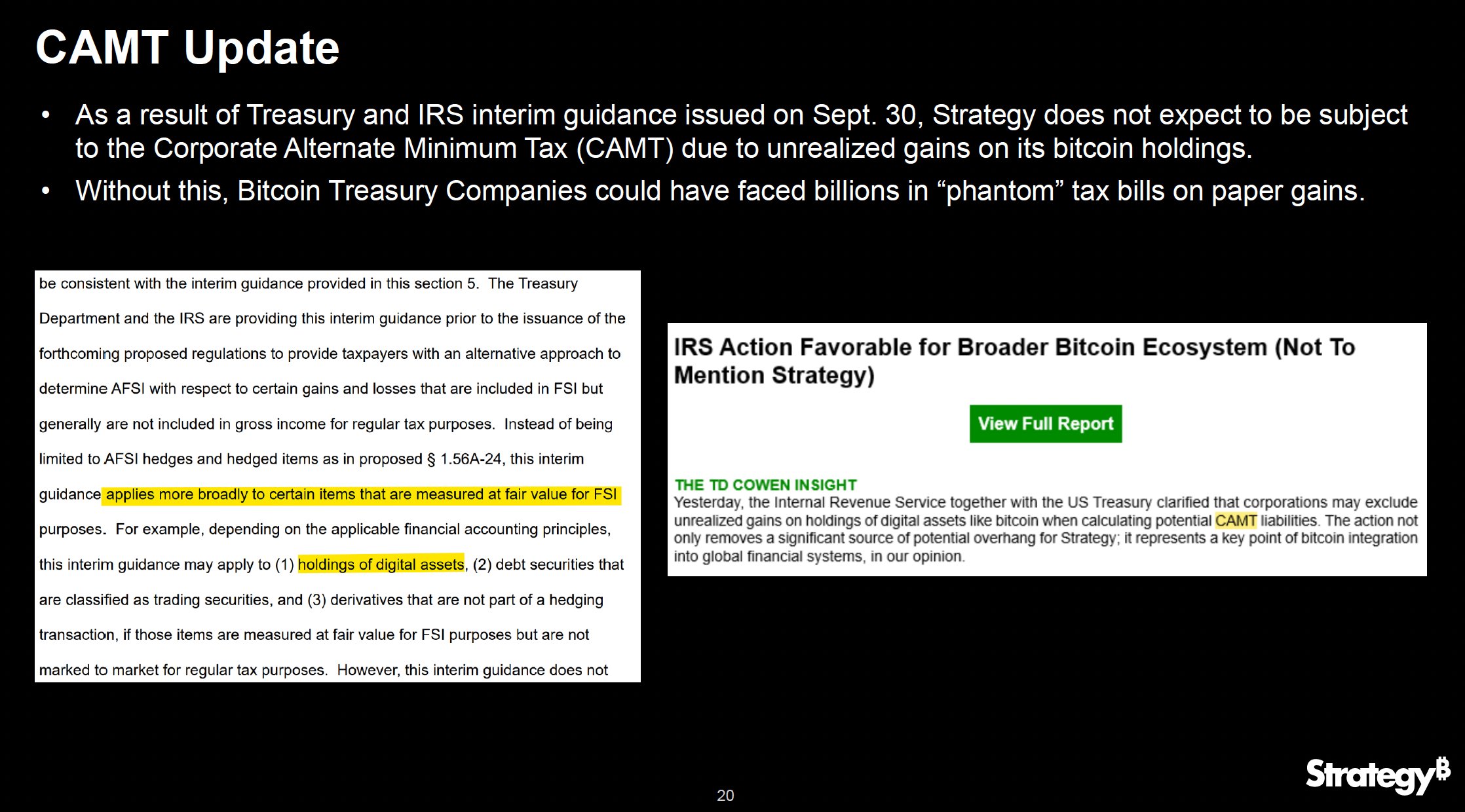
Strategy does not rely on exchanges for leverage. It takes no trading leverage. Its total debt remains about ten percent of assets. It does not rely on stablecoins for liquidity. It controls its own liquidity. It issues digital credit and equity instruments directly.
A Different Way to Look at Strategy
How you view Strategy ultimately depends on how rigid your beliefs about Bitcoin are.
If you believe Bitcoin’s role can never evolve beyond passive holding, then Strategy’s structure will feel uncomfortable. If you are willing to update your beliefs, Strategy functioning as a de facto central bank for Bitcoin can be viewed as a feature rather than a flaw.
Strategy is not becoming a Bitcoin central bank by decree. It is demonstrating what monetary infrastructure built on sound money looks like.
Once you see the structure, you cannot unsee it.
← Part 2: Is the Federal Reserve Evil? | ← Part 1: Hiding in Plain Sight

Founding Member
Mike Flaum, known as Grain of Salt, is CEO of Log Scale Investments and a Founding Member of True North. He covers Federal Reserve policy, monetary theory, and macro forces shaping Bitcoin's role as a treasury asset.
Related Research
Balancing of MSTR and STRC
Mar 16, 2026
AnalysisSTRC, Bitcoin's Exponential Pump, MSTR to 20k & BTC to 5MM — Money, The Perfect Product
Jan 21, 2026
AnalysisHiding in Plain Sight
Jan 20, 2026
AnalysisStrategy is Trading Bitcoin's Power Law Trend
May 19, 2026
CommentaryThe Original 1,000x — Standard Oil Is Happening Again
Mar 15, 2026
AnalysisBillions of Dollars backed by STRC.
Mar 13, 2026