Is the Federal Reserve Evil?
Originally published on X
Related Research
This is Part 2 of a 3-part series. Read Part 1: Hiding in Plain Sight and Part 3: Bitcoin Is Missing a Central Bank. Strategy Is Building One.
It May Not Be What You Think
2 of 3
Why the real problem isn’t monetary policy, it’s political reality.
“Every budget is balanced. There is no such thing as an unbalanced federal budget. You’re paying for it.”
Milton Friedman https://youtube.com/shorts/QSHCpU5KNpg?si=roDXHwCX9GSZBBFz
The first time I heard that quote, my reaction was simple: WTF.
I have a degree in economics (1989). I understood budgets. I understood fiscal and monetary policy. I understood that the Fed prints money.
But I had never heard anyone frame it this way: the budget is always balanced, because whatever Congress overspends eventually gets paid for, through taxation, borrowing, or monetary debasement.
At first it sounded wrong. Then it clicked. Of course the budget is “balanced.”
The shortfall doesn’t disappear. It’s absorbed through money creation and currency debasement. And once that framing locked in, the entire system suddenly made sense.
A civics lesson most people never got
If you don’t understand the difference between fiscal policy and monetary policy, nothing about the Fed, inflation, debasement, Bitcoin, or deficits will make sense. Most people were never taught this clearly.
Think of the dollar system as governed by two separate entities.
Entity one: Fiscal policy
Controlled by Congress and the President.
- Congress (House and Senate) writes the budget
- They decide spending and taxation
- They pass the bills
- The President signs them into law
If spending exceeds revenue, that creates a deficit. That deficit is a political decision. The Federal Reserve does not vote on it, approve it, or design it.
Today, that deficit is roughly $2 trillion per year.
Entity two: Monetary policy
Controlled by the Federal Reserve, led by Jerome Powell and the Board of Governors.
The Fed does not control spending. It does not write budgets. It does not determine deficits.
Its mandate:
- Promote stable employment
- Maintain stable prices
In practice, that means managing liquidity, interest rates, and financial stability in the world created by fiscal policy.
That distinction is everything.
What the data actually shows
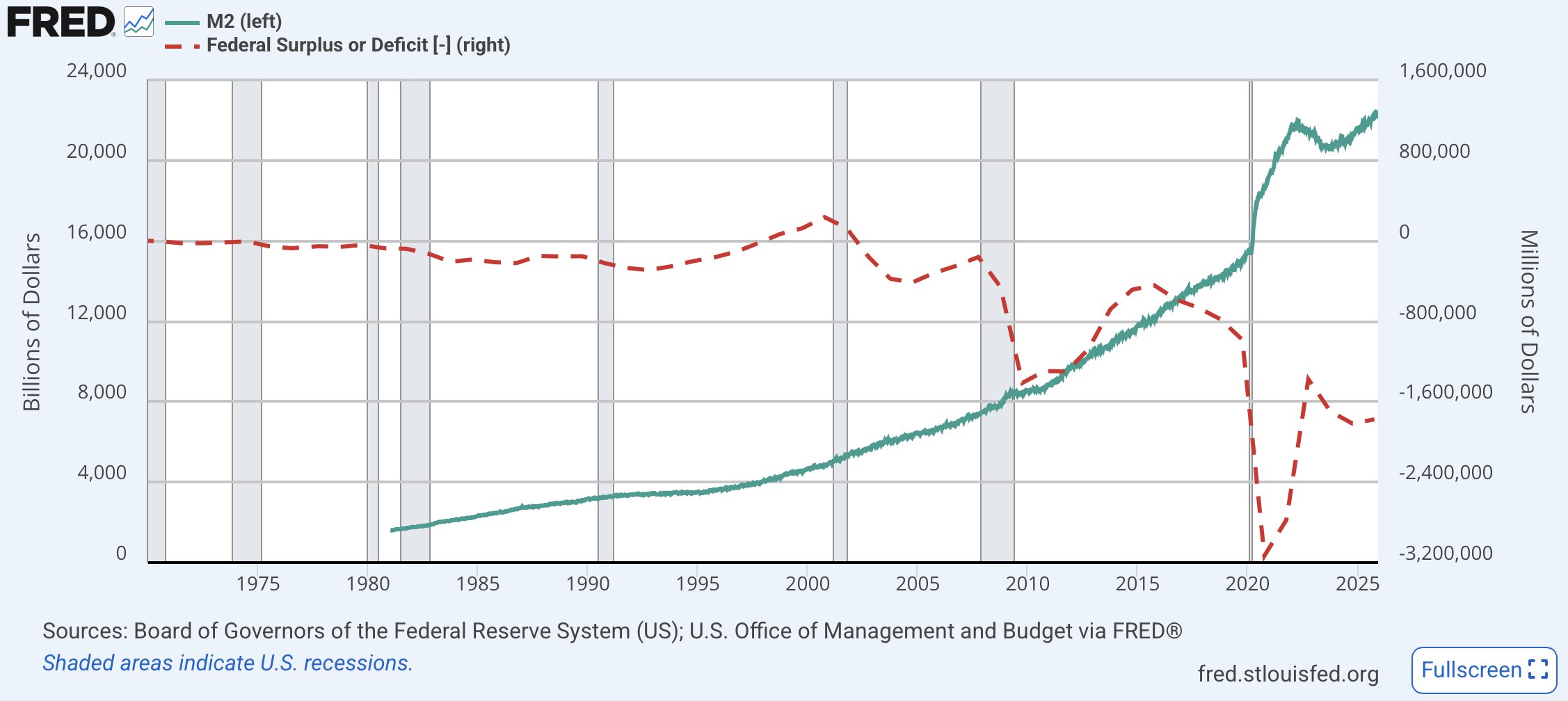
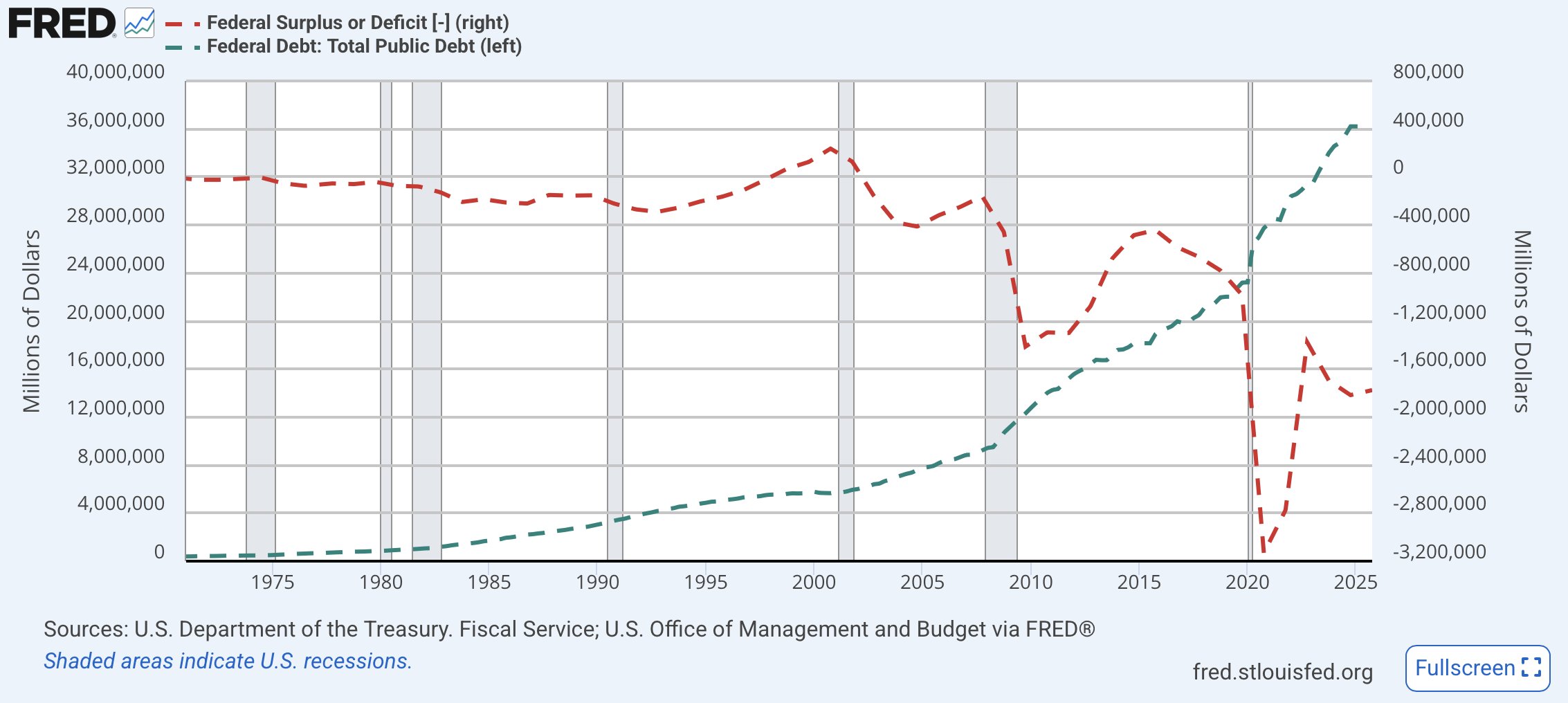
If you look at long-term data from the St. Louis Federal Reserve (FRED), two things become visually obvious.
The first chart compares M2 money supply to the annual federal surplus or deficit starting in 1970. Federal deficits are structurally persistent for more than five decades, with only a brief surplus around 1999–2001. Meanwhile, M2 grows gradually for decades, steepens after 2008, and accelerates sharply after 2020. You don’t need complex math, just the shape of the curve tells the story: persistent deficits become normalized, and monetary policy adapts to accommodate them.
The second chart compares total public debt to annual deficits. It shows the compounding effect directly. Each deficit mechanically adds to the debt stock. There is no natural reset. After every crisis; 2008, then 2020 the system does not revert to discipline. It simply ratchets higher.
This isn’t ideology. It’s arithmetic.
Why the Fed ends up “printing”
Once Congress authorizes trillion-dollar deficits, the Treasury must issue enormous amounts of debt. That debt must be absorbed by markets. If it isn’t, bond prices fall, yields spike, liquidity dries up, and financial conditions tighten rapidly.
That’s when the Fed intervenes. Not because Powell wants to debase the currency. He has no choice. If the Fed refused to act as a backstop, interest rates would surge, asset prices would violently reprice, credit markets would destabilize, and the political fallout would be severe.
So when people say, “The Fed is evil, they’re printing trillions,” they’re often blaming the responder instead of the cause.
The cause is Congress and the President.
Why we still need a functioning credit market
Many argue that if we eliminated the Fed and forced balanced budgets, the system would fix itself. That ignores a basic reality: modern economies require functioning debt and credit markets.
Treasuries, mortgages, corporate bonds, consumer loans, these are not distortions. They are the infrastructure that allows economic activity to function at scale.
Imagine a world without credit.
You want to buy a $25,000 car. Without financing, only people who can save $25,000 in cash can buy one. No loans. No monthly payments. No access for most people.
Housing becomes even more extreme. Without mortgages, only people with hundreds of thousands saved in cash could buy homes. Most people would rent for life. Mobility collapses. Investment collapses.
Credit markets exist because they enable growth. The Federal Reserve exists because modern credit markets require a stabilizing institution.
The problem isn’t that we have a Fed. The problem is that the system became structurally dependent on perpetual deficit expansion.
This didn’t start with Powell
Blaming Jerome Powell misunderstands the timeline.
The structural shift began in 1971, when the U.S. left the gold standard. That removed the hard constraint on fiscal behavior. From that moment forward, deficits could expand without an automatic corrective mechanism.
Then came 2008 and 2020.
Leverage expanded. Risk was mispriced. When the system broke, the response rewired expectations permanently. Markets, politicians, and institutions began to assume intervention would always arrive in moments of stress.
Debt accelerated. Money supply accelerated. Dependency formed.
Today, interest on the national debt alone rivals major federal programs.
The dollar isn’t collapsing. It’s impaired
There is no secret conspiracy.
But the dollar is structurally impaired by deficits that cannot be politically resolved. And impairment changes behavior.
When people realize the currency they store their labor in is debased at a predictable rate, they adapt. They seek alternatives.
Why this leads to Bitcoin, gold, and equities
Not bonds. Bonds are structurally broken in this environment, yields do not outrun monetary debasement.
The Fed is just an easy scapegoat. It emerged because post-1971 monetary architecture made an alternative necessary.
Bitcoin didn’t emerge because people hated the Fed, its creation was due to the bailouts of the 2008 financial crisis. Its adoption accelerated because post-2008 policy made the weakness obvious.
People are opting into the only assets that historically survive irresponsible political behavior.
← Part 1: Hiding in Plain Sight | Continue to Part 3: Bitcoin Is Missing a Central Bank. Strategy Is Building One. →

Founding Member
Mike Flaum, known as Grain of Salt, is CEO of Log Scale Investments and a Founding Member of True North. He covers Federal Reserve policy, monetary theory, and macro forces shaping Bitcoin's role as a treasury asset.
Related Research
Bitcoin and Inflation: Protecting the Value of Your Work
Mar 30, 2026
CommentaryWe Live in a Dissimulation
Jan 23, 2026
CommentaryThe Dual Decay
Jan 20, 2026
CommentaryThe Fracture: Breaking Bitcoin's Power Law
Aug 27, 2026
Research PaperTrust Is Civilization's Oldest Technology
Aug 13, 2026
CommentaryBitcoin Is.
Aug 9, 2026