Strategy Breaks Bitcoin
Originally published on X
Related Research
GREAT for $MSTR $STRC and @Strategy share holders.
Most people don’t understand what’s happening in Bitcoin right now, not because the data isn’t available, but because almost nobody structures it. The difference isn’t intelligence. It’s the willingness to build a simple table, lay out the rows and columns, and let the system reveal what’s actually happening.
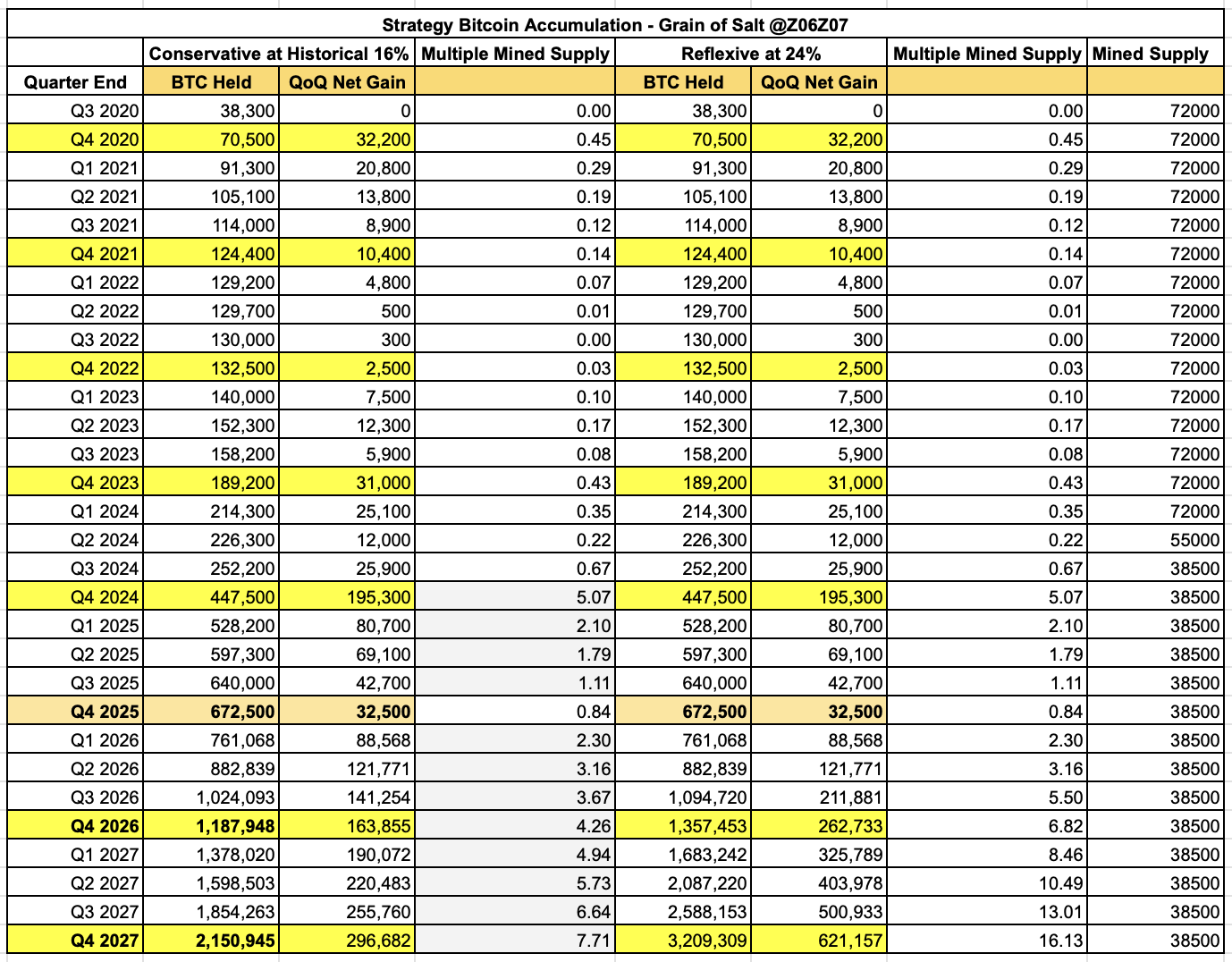
I started with something straightforward: Strategy’s Bitcoin purchases by quarter. No narratives, no price predictions, just historical data. When you lay it out, one number immediately stands out. In Q4 2024, Strategy acquired roughly 195,000 Bitcoin in a single quarter. That alone is extraordinary. But what matters more is how that compares to supply.
After the April 2024 halving, Bitcoin produces roughly 38,500 coins per quarter. In Q4 2024, Strategy didn’t just keep up with supply, it absorbed 5.1x the total Bitcoin mined that quarter.
That wasn’t normal. That wasn’t cyclical. That was a structural break.
Now fast forward.
In Q1 2026, during roughly a 40% drawdown from Bitcoin all-time highs, Strategy is on pace to acquire around 100,000 Bitcoin, after acquiring 88,568. That’s already 2.3x the mined supply, in what most people would call a weak or bear market.
Think about that for a second.
This is not discretionary buying. This is not sentiment-driven. This is a persistent, system-level buyer accumulating Bitcoin regardless of price direction.
And here’s where it gets interesting.
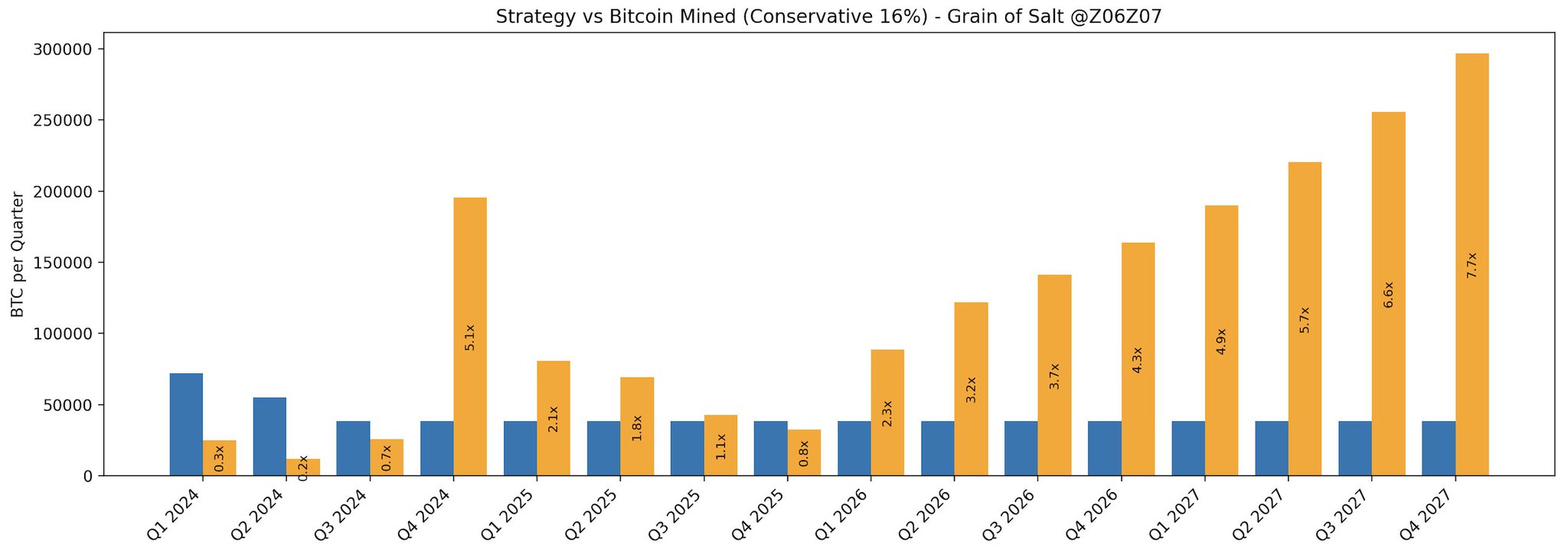
If you project Strategy’s accumulation forward using its historical growth rate, roughly 16% per quarter, something subtle appears. Despite steady growth, Strategy doesn’t exceed that Q4 2024 peak of 5.1x mined supply again until Q2 2027, when it reaches approximately 5.7x.
That tells you something critical.
Q4 2024 wasn’t just a big quarter. It was an early spike of reflexivity, where capital deployment dramatically outpaced both mining supply and the trendline of accumulation.
Even more interesting, there’s a temporary dip in late 2025. In Q4 2025, Strategy’s multiple drops below 1.0x. That’s not because demand disappeared. It’s because the company raised approximately $2.25 billion in cash, temporarily pausing the conversion of capital into Bitcoin. In other words, the dip isn’t weakness, it’s staging.
Now step back and look at the system as a whole.
You have a persistent buyer that can absorb multiple times the newly mined supply. You have a post-halving environment where issuance has been cut roughly in half. And you have a holder base that does not behave like a traditional commodity market.
Bitcoin is not evenly distributed. A relatively small number of early holders control a disproportionate share of the supply. The exact number doesn’t matter. What matters is behavior. These are not forced sellers. They’ve held through multiple cycles, often for more than a decade.
If Bitcoin moves from $100,000 to $300,000 to $500,000, they don’t market dump their entire position. They sell small amounts into strength — five percent, maybe ten percent — and retain the rest. Supply doesn’t flood the market. It leaks out slowly, and only at higher prices.
At scale, Bitcoin behaves less like a traditional commodity and more like a Veblen asset. As price rises, demand increases, but willingness to sell does not increase proportionally. In some cases, it decreases. That creates a non-linear supply curve.
Now combine everything.
- A persistent, price-insensitive buyer
- A structurally reduced supply of new Bitcoin
- A holder base that releases supply slowly and reluctantly
That is not a linear system. That is a reflexive system.
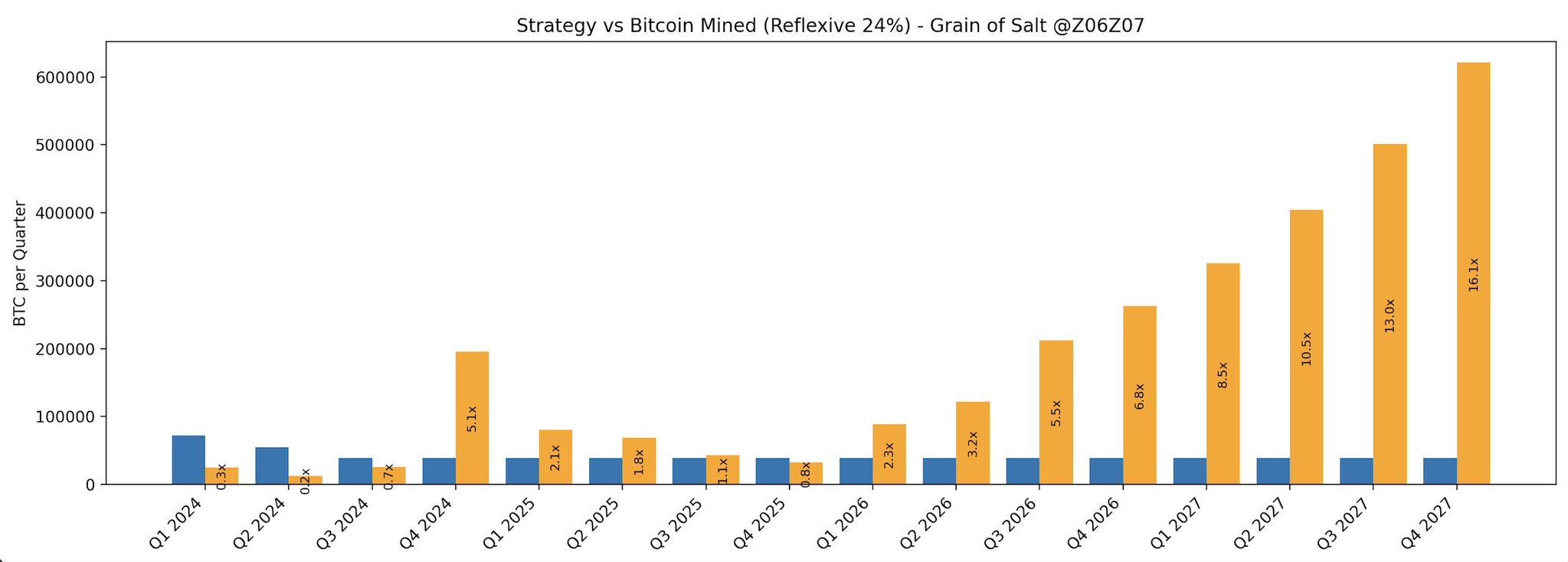
So instead of predicting price, I extended the behavior. If Strategy continues accumulating at its historical rate, it approaches roughly 2 million Bitcoin by the end of 2027. Under a more reflexive scenario, closer to 24% growth, it accumulates 3+ million Bitcoin over the same period.
At that point, something changes. Not gradually, but suddenly.
The market is no longer anchored to the marginal cost of mining or the flow of new supply. It becomes anchored to the marginal willingness of holders to sell.
That’s the inflection point. That’s the tipping point. That’s the “hockey stick” everyone talks about but rarely defines.
And here’s the part most people will miss. We may already be in it. Strategy isn’t just buying Bitcoin. It’s interacting with the supply curve in a way that forces the rest of the market to reprice.
It’s not breaking Bitcoin in the literal sense.
It’s triggering the repricing event the market has been waiting for.
Bitcoin is moving from a system governed by linear supply to one governed by conviction, scarcity, convexity, and reflexivity.
Once a single buyer consistently absorbs multiples of newly mined supply, price is no longer anchored to production — it’s anchored to the willingness of holders to sell.
That’s the shift.
From linear to reflexive.
From supply-driven to conviction-driven.
And when that shift happens, price doesn’t drift higher.
It reprices, violently.
Previous article for more context: The Balancing of MSTR and STRC

Founding Member
Mike Flaum, known as Grain of Salt, is CEO of Log Scale Investments and a Founding Member of True North. He covers Federal Reserve policy, monetary theory, and macro forces shaping Bitcoin's role as a treasury asset.